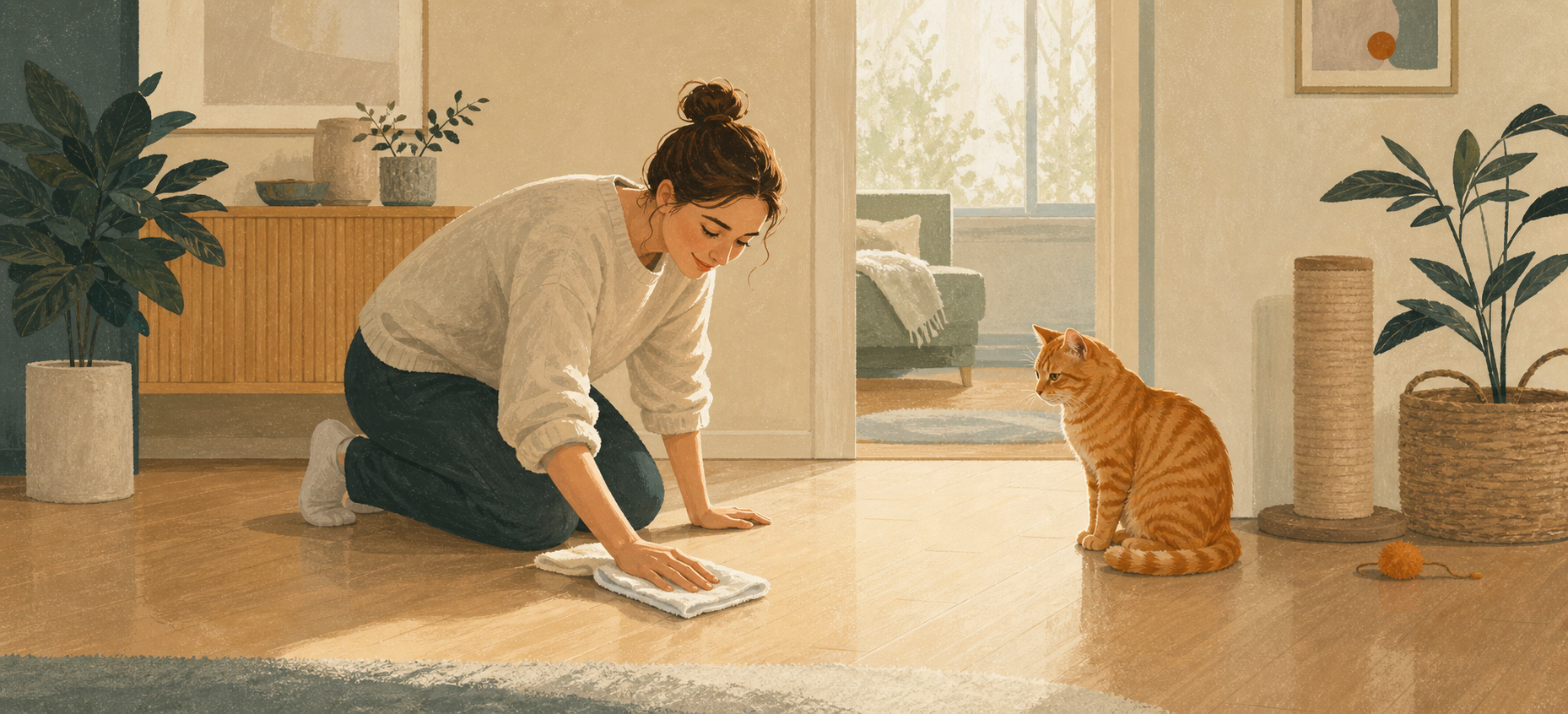
Short answer: blot up what you can, then use a cat-urine cleaner exactly as its label directs for that surface and contact time. Skip ammonia-based cleaners and heavy fragrance. Cleaning may reduce residue at a repeat spot, but it cannot tell you why your cat urinated there. For a sudden or persistent change, speak with a veterinarian first.
Vet first: If your cat is repeatedly straining, producing little or no urine, crying out, showing blood, vomiting, becoming weak or collapsed, or seems in severe pain, contact a veterinarian or emergency clinic now. Do not wait for a cleaner to work. A new or persistent change also deserves a veterinary conversation. AAHA: Why won’t my cat use the litter box?
What should you do before cleaning a cat-urine spot?
Gently keep your cat away from the wet area, without scolding. If you did not see what happened, write that down plainly. The time and location are useful clues, not a diagnosis. A photo is optional and should never come at the cost of disturbing your cat. Before reaching for a product, note whether this is carpet, upholstery, bedding, sealed flooring, or unfinished wood; each material has different limits on what can safely get wet.
If this is a new accident, pause the product decision and contact your veterinarian. House-soiling can have medical, environmental, and social contributors, and more than one can occur at once. AAFP/ISFM house-soiling guideline
Do enzyme-based cleaners work better than ordinary cleaners?
An enzyme-based pet-urine cleaner is a sensible category to compare: veterinary and animal-welfare guidance specifically mentions enzymatic cleanser for urine accidents. It is still the label—not the word “enzyme”—that tells you what to do. Formulas, fabrics, dilution, dwell time, and rinsing instructions vary. “Natural,” “pet-safe,” and “odor control” are marketing terms, not interchangeable evidence of performance.
| Cleaner approach | What it is designed to do | What to check | What it cannot tell you |
|---|---|---|---|
| Enzyme-based cat-urine cleaner | Break down or remove organic urine residue according to the formula’s directions | Cat-urine use, surface compatibility, required saturation/contact time, ventilation, and drying instructions | Whether the cat is medically well or why the spot was chosen |
| Ordinary detergent or soap | Lift surface soil and some residue | Whether the material can be washed, whether rinsing is required, and whether fragrance remains | Whether odor below a surface has been reached |
| Ammonia-based cleaner | Cleans some household soils but smells similar to urine to a cat | Avoid for urine spots; never mix cleaning chemicals | It does not provide a behavior plan |
| Fragrance or deterrent spray | Masks or changes smell for people, or is marketed to discourage access | Ingredients, label directions, and whether the cat can contact the residue | A masked smell is not the same as removed residue |
Text summary: an enzyme-based cat-urine product is the most directly relevant category for a urine spot, but the label and surface still control the method. Ordinary cleaning may be useful for general soil. Ammonia-based products and strong scents are poor choices for this problem. No cleaner answers the health or behavior question.
The AAFP/ISFM guideline advises avoiding strong chemicals and ammonia-based products around litter-box and urine cleaning. ASPCA also recommends an enzymatic cleanser and warns that ammonia can attract a cat back to the same area. ASPCA litter-box problems
How do you clean carpet, upholstery, bedding, and hard floors?
- Blot fresh urine. Press absorbent towels onto the area; do not scrub urine deeper into fabric. Wear gloves if you prefer, and ventilate the room.
- Check the product and material first. Test a hidden area for colorfastness. Do not saturate wood, electronics, leather, or a material the label excludes.
- Apply as directed. Some enzyme products need enough liquid to reach the residue and a longer contact time; others do not. Never invent a dilution or combine products.
- Let the area dry fully. Keep the cat away while the label requires and until the surface is dry. If padding, underlay, or subfloor still smells, surface cleaning may not have reached the source; ask a professional cleaner or replace the affected material where necessary.
- Re-check without adding fragrance. A dry room that smells clean to you may still contain residue, and a fragrance can add a new sensory change. Repeat only according to the product instructions.
For washable bedding, follow the fabric-care label and the cleaner’s laundry directions. For a mattress or upholstered cushion, do not assume a light surface mist has reached the filling. If the spot is near a litter box, doorway, window, or another cat’s route, make a note before you rearrange the room. That context may be more useful at a veterinary appointment than a guess about motive.
Why can a cat return to a cleaned spot?
A repeat location may involve remaining odor, a preferred surface, litter-box access, household traffic, social pressure, or a medical problem. More than one can be true. The spot itself cannot identify the cause. Think of cleaning as one useful part of the plan: keep the route to a suitable litter box open, avoid punishment, and discuss new or persistent urination with a veterinarian.
After the vet-first step, you can temporarily block access with a closed door, washable cover, or furniture rearrangement if that does not remove access to essential resources. Do not use a strong repellent scent as a substitute for reviewing the setup.
What did Pico’s household learn about repeat spots?
Pico’s log: cleaning was not the whole experiment
In Pico’s household, we wrote down the location and cleaning sequence before touching the litter box or changing the room. That order mattered to us: a cleaner could change how a surface smelled, yet it did not answer whether the original event was medical, environmental, or social. We did not treat a cleaner as the answer, and we do not know whether the surface was the only relevant variable.
Pico’s experience is a single household story, not veterinary advice or a guarantee for another cat.
What is the calm next-step checklist?
| Step | Do this | Stop and escalate when |
|---|---|---|
| Safety | Check the urgent signs and call the vet for a new or persistent change | Straining, little/no urine, blood, vomiting, weakness, collapse, or severe pain |
| Observation | Record surface, location, time, amount if observed, and nearby events | You are tempted to call the cause a diagnosis |
| Cleaning | Use a compatible cat-urine cleaner exactly as labeled; avoid ammonia | The material is damaged, the smell persists below the surface, or chemical exposure occurs |
| Environment | Keep litter-box access clear and avoid punishment | Another cat, person, door, or appliance blocks the route |
Text summary: safety and observation come first; cleaning follows the product label; environmental changes stay small and reversible. A clean surface is useful housekeeping, not proof that a health or behavior issue is resolved.
How does this connect to Catpip’s wider plan?
Use the vet-first cat-peeing-everywhere pillar for the decision path, the spraying-versus-peeing observation guide for photo-free clues, and the cat spraying and urine-odor pillar for the wider repeat-spot context. If litter access may be part of the pattern, read the multi-cat tension resource plan.
CTA: Save the four-step checklist, bring your observations to your veterinarian, and only then run a small, label-consistent cleaning trial.
FAQ
What is the best cleaner for cat urine?
There is no universal brand winner in this article. Compare an enzyme-based product labeled for cat urine by its surface directions, contact time, ingredients, fragrance, drying instructions, and suitability for the material. Follow the label and do not mix products.
Does vinegar remove cat urine?
Do not treat vinegar as a universal urine-removal method. It may change the smell without reaching residue below a surface, and mixing cleaners can be unsafe. Use a product intended for cat urine and follow its directions.
Can I use ammonia to clean cat pee?
Avoid ammonia-based cleaners for cat-urine spots. Veterinary guidance notes that ammonia can smell similar to urine to a cat and may make the location more attractive. Never mix household cleaners.
Why does my cat keep peeing in the same place after cleaning?
Residual odor is one possibility, but access, substrate preference, social pressure, household change, and medical problems can also be relevant. A new or persistent pattern needs veterinary advice; cleaning alone is not a diagnosis or behavior plan.
Should I use a cat-urine cleaner before calling the vet?
You can calmly protect and blot the area, but do not delay veterinary contact for a new, persistent, or concerning urination change. Use the urgent-care box above for emergency signs.
Sources and editorial note
- AAFP/ISFM Guidelines for Diagnosing and Solving House-Soiling Behavior in Cats — veterinary work-up, litter-box management, and ammonia/chemical guidance.
- ASPCA: Litter Box Problems — enzymatic cleaning and ammonia warning.
- Ohio State Indoor Pet Initiative: How to Clean-Up Cat Urine — surface-cleaning sequence and ammonia caution.
Not veterinary advice: This article provides general educational information and describes one household’s experience. It does not diagnose, treat, or replace advice from a licensed veterinarian. If your cat’s behaviour or health changes, contact your veterinarian; seek urgent care for emergency signs. Product information is not a recommendation for every cat, and your veterinarian should advise on medicines, supplements, and medical conditions. Pico’s experience is not evidence that the same approach will work for another cat.